Financial Deep Dive on Clear Channel Outdoor Acquisition

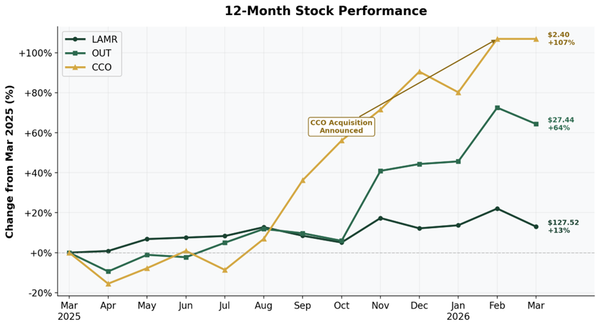
On February 9, 2026, Clear Channel Outdoor Holdings (NYSE: CCO) agreed to be taken private by Mubadala Capital and TWG Global in a $6.2 billion all-cash transaction. Shareholders to receive $2.43 per share, representing a 71% premium to CCO's "unaffected" share price of $1.42 before deal rumors surfaced in October 2025. The deal was unanimously approved by the board and is expected to close by end of Q3 2026.
How Clear Channel Got Here
When iHeart emerged from bankruptcy in May 2019, it spun out CCO as a standalone, pure-play OOH public company. After the bankruptcy, CCO got started with roughly $4 billion in debt on its books. Although CCO ran a good operation, the debt was always overhanging and forced CCO to spend the next six years selling off ALL of its international assets just to buy time. By the end of 2025, CCO was a purely U.S. and airport-focused business carrying approximately $5.3 billion in debt — actually higher than the ~$4 billion it inherited at spinoff, as refinancing costs and additional borrowings more than offset the asset sale proceeds.
Financials at the Time of Sale
CCO's operating business was actually performing well heading into the deal. Full-year 2025 revenue came in at $1.604 billion (+6.6% YoY), and Adjusted EBITDA reached $504.8 million (+6.1%). The airport segment was the standout grower, with Q4 digital airport revenue surging 23.5% to $91.6 million.
Its balance sheet, however, told a different story entirely:
| Metric | Value |
|---|---|
| Total Debt | ~$5.3B |
| Debt / EBITDA | ~8.3x |
| Interest Coverage | ~0.73–0.80x |
| Annual Cash Interest | ~$400M |
| Altman Z-Score | -1.72 (distress zone) |
An interest coverage ratio below 1.0x means CCO was earning less EBITDA than it owed in interest, meaning the business could not service its debt from its own operations.
Deal Structure
The total transaction size including existing debt is approximately $7.8 billion. The structure:
- ~$3 billion new equity from Mubadala + TWG
- Preferred equity from Apollo Global Management (undisclosed amount)
- New debt financing led by JPMorgan Chase and Apollo funds
- ~$5.3 billion in existing CCO debt assumed/refinanced
The new equity injection will probably save CCO. $3 billion applied to CCO's balance sheet would reduce net leverage from ~8.3x to something closer to 4–5x Debt/EBITDA, helping manage interest expense and in line with competitors like OUTFRONT.
Valuation: Was the Price Fair?
At $6.2 billion EV against ~$505 million in 2025 Adjusted EBITDA, the deal was priced at roughly 12.3x EV/EBITDA. Compared to peers:
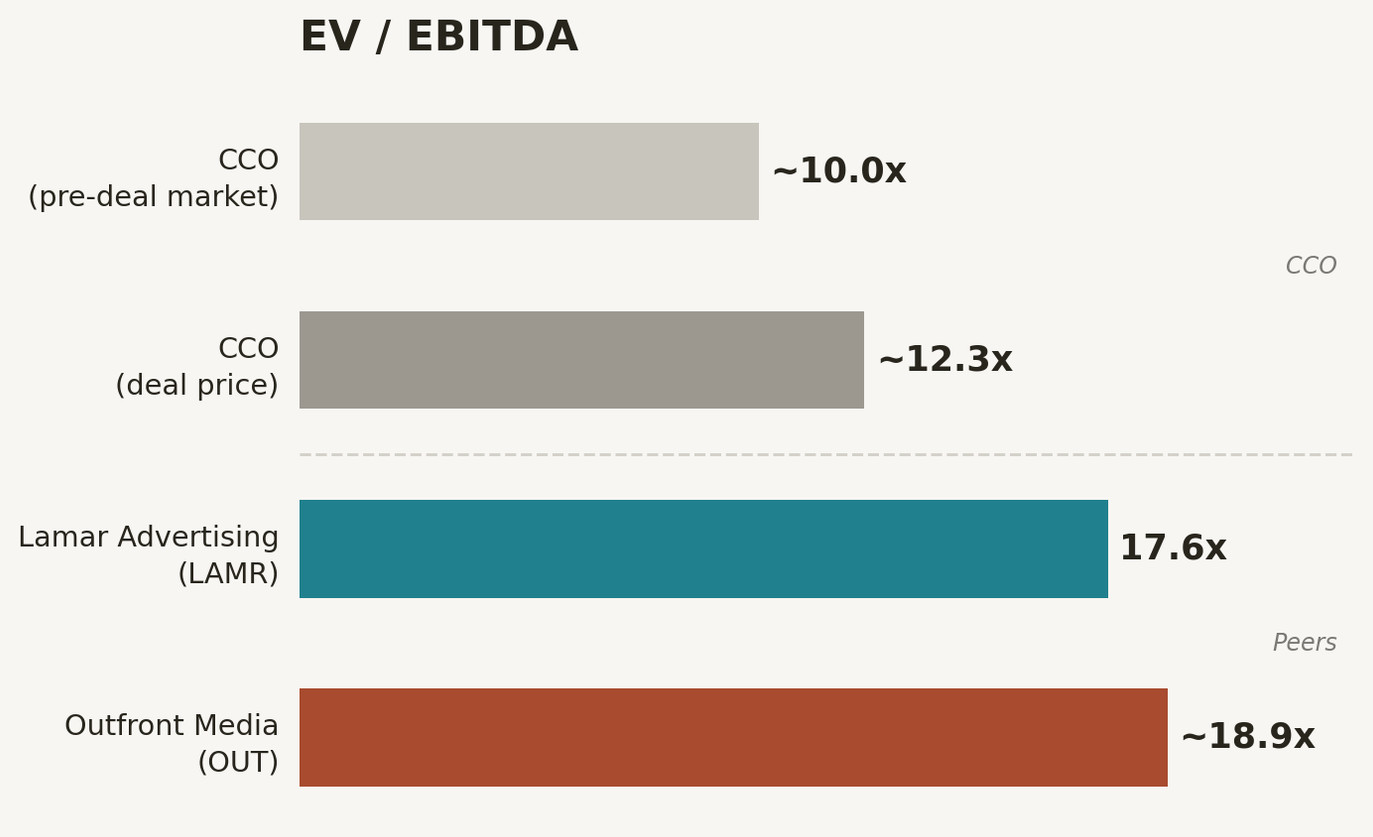
The 5–6x discount to peers is entirely attributable to the debt load.
The Investment Thesis
The bull case rests on a straightforward multiple arbitrage: Mubadala enters at ~12.3x EV/EBITDA on a business where Lamar trades at 17.6x and Outfront at ~18.9x. That gap exists entirely because of leverage — not because CCO's underlying business is inferior. Strip out the capital structure, and CCO operates the second-largest OOH network in the U.S., with airport concession contracts that are among the most defensible advertising assets in the country.
The equity injection is the enabling condition for all of this. At ~8.3x Debt/EBITDA today, CCO cannot invest aggressively, cannot absorb an advertising downturn, and cannot attract a premium valuation. At 4–5x post-injection — roughly in line with Outfront, though still above Lamar's ~3.5x — the business becomes financeable, with positive interest coverage and genuine capital allocation flexibility.
Billboard Economics’ Take
If new ownership can take control of the balance sheet and deliver on growth through re-investment into digital conversions, the acquisition makes sense, and there is potential to get up to the same EV/EBITDA multiples as its competitors and create value.
You can subscribe for free by entering your email below. Our newsletter is free.